


Crendon Street Park Naturalisation
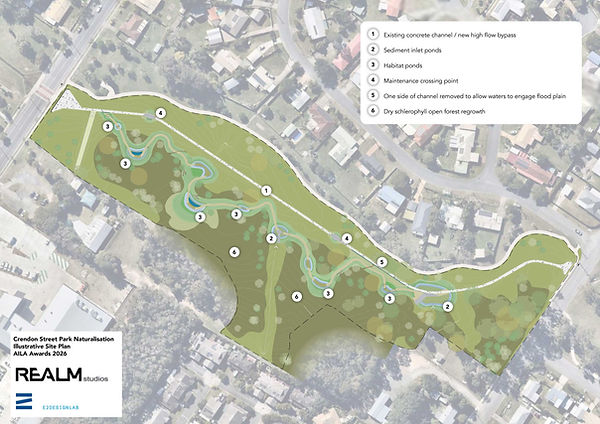
This project diverts untreated stormwater from a shallow concrete drain into a meandering naturalised waterway and ponds that are designed to improve stormwater quality, remove sediments and suspended pollutants, and expected to increase groundwater infiltration and improve aquatic and terrestrial habitat values.
During large storm events flows are redirected back along the modified drain. The route of the new waterway deliberately winds through a stand of dry schlerophyll open forest regrowth. As well as allowing waters to better engage the floodplain, park visitors can now use new informal crossing points to engage with the sights, sounds and senses of nature.
Whilst Council required the project to be led by a stormwater engineer, the brief also prescribed a landscape architect be involved to ensure the new work integrated well into the existing parkland.
At the detail level this entailed appropriate consideration of a range of planting treatments for revegetation, water quality treatment, soil stabilisation, erosion control and habitat; integration with pre-clearing vegetation communities and existing species; integration of naturalistic features that could provide subtle cues for nature play and interpretation of the ecological landscape; and to achieve the above whilst also satisfying the hydraulic flood modelling criteria.
STRATEGY
The key strategic project move was to meander the new water quality treatment infrastructure – stream and ponds – through the existing stand of open forest regrowth. This enabled stormwater to engage with a broader floodplain, but without taking existing passive open space offline in the rest of the park. Secondly, construction work was avoided in the vicinity of existing high value mature trees in the park. Thirdly, through the placement and detailed design of informal crossing points and the upstream and downstream extents of new works, it increased the opportunity for community to access a new range of recreational experiences with the park.
INNOVATION
The design at Crendon Street Park innovates in its site specificity. It did not assume that complete removal of the existing shallow drain was the best outcome, or that the area of regrowth forest should be off-limits. The delivered design demonstrates how a waterway can be allowed to engage with a broader floodplain whilst still managing flood risk. At the 2025 Stormwater Queensland Awards, the project was industry recognised for its excellence in achieving high levels of both stormwater management and community benefit with a cost-effective design.
ENGAGEMENT & PARTNERSHIP
Construction was eagerly followed by the neighbouring kindergarten. Following construction, with E2Designlab we facilitated an information session and a walk around the new waterway talking about how it will help clean the water and provide a place for animals to live. We prepared colouring sheets showing some of the ‘before and after’ features, which the class completed later.
SUSTAINABILITY
Overall, the planting design strengthens the existing open forest character and the requirements for deep and shallow marsh and ephemeral wetland zones, with proposed species drawn from a range of sources. Planting design responded to technical requirements. Firstly, flooding assessment revealed minimal freeboard from peak flood levels to private property. A special ‘floodplain’ planting zone was required with species less than 200mm high, to avoid increasing the hydraulic roughness of the floodplain and potentially affecting afflux. Where other species were nominated by Council teams, they were included in very low quantities to avoid adverse flood impacts. Secondly, hydraulic modelling identified locations requiring additional scour protection. As well as strengthened coir net, plants in these locations were required to have dense, deep, fibrous and/or binding roots.
Country
Kabi Kabi
Location
Burpengary, QLD
Client
City of Moreton Bay
Year
2025
Photography
Christopher Frederick Jones